The Land Auction Hiding Inside West University Place's Home Prices
September 24, 2026
September 24, 2026
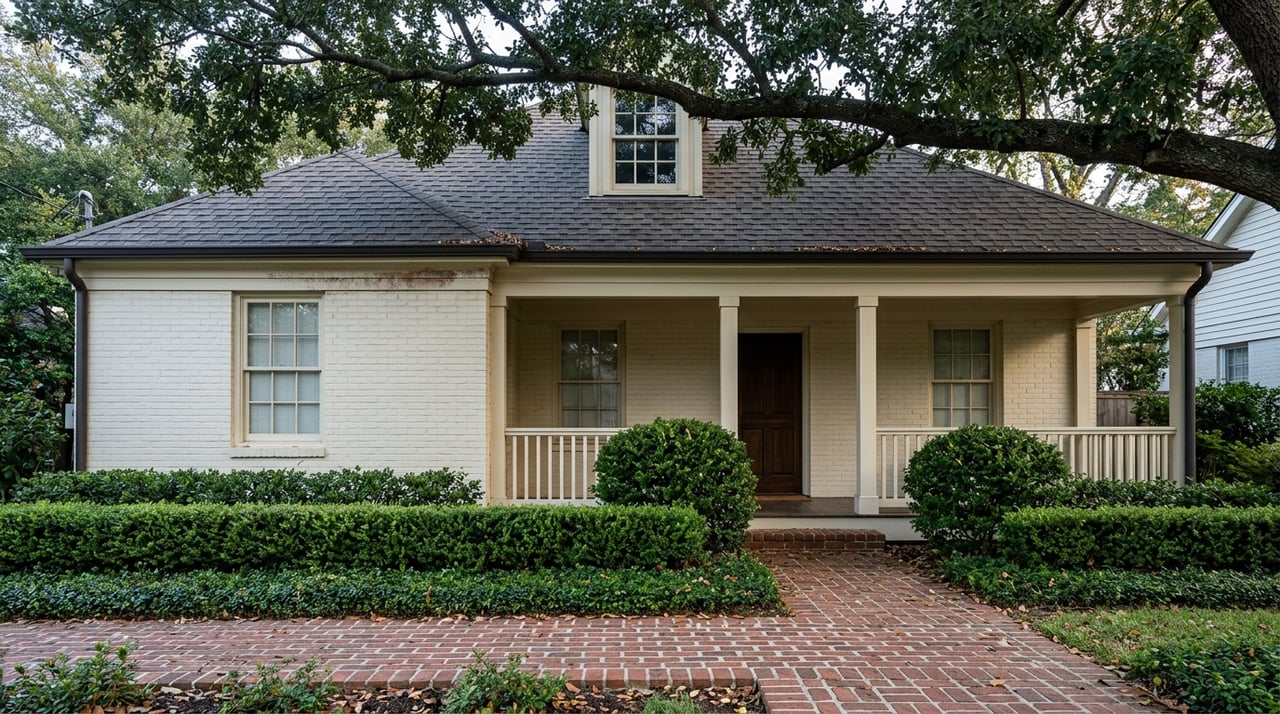
Walk two blocks in West University Place this fall and you can find a 1940s cottage and a brand-new custom build sitting on lots that are functionally identical. Same square footage of dirt. Same zoning. Same walk to West U Elementary. And yet one is priced like a starter home in a different city, and the other is priced like a second home in Aspen.
That gap is not a pricing mistake. It is the entire market working exactly as designed. West University Place does not have one housing market with a median price. It has two, running side by side under a single ZIP code, and most of the numbers quoted about this neighborhood only describe one of them at a time.
Reporting on West U's real estate economics from June 2026, cited by Hoodline this September, put a number on something longtime residents already sense: unimproved lots under 1940s-era cottages are trading for roughly $1.4 million based on land value alone, while new luxury custom builds on comparable lots are asking closer to $3.8 million. That is not two ends of a price range. It is two separate products being sold under the same street address.
You can see this in the listing language itself. Search current West U inventory and you will find homes explicitly marketed with some version of "livable, but sold for the lot." The house is a placeholder. The buyer is paying for the ground underneath it, and everyone involved in the transaction knows it.
This matters because it changes what a comp actually is. A renovated 1950s home is not competing with a five-year-old rebuild for the same buyer, even if they are three doors apart. They are priced off entirely different inputs. One is priced off land scarcity and renovation quality. The other is priced off construction cost, finish level, and how much a buyer will pay to skip the two-year process of tearing down and rebuilding themselves.
If you have already looked up West U's home values online, you have probably noticed the numbers don't match depending on where you look. As of September 2026, Houston's MLS-sourced average home price for West University Place sits above $2.5 million, with price per square foot near $628. Zillow's automated home value estimate for the same area, last updated at the end of June 2026, put the typical home value closer to $1.83 million.
That's a gap of roughly $700,000 between two numbers describing the same city.
Neither number is wrong. They are measuring different things. The MLS average is pulled from whatever is actually listed and closing right now, which this year has included a run of new-construction sales at the top of the market. Zillow's typical-value estimate is a smoothed calculation built to reflect the entire housing stock, including the untouched 1940s and 1950s homes that haven't traded hands in decades and never show up as active new-build comps. When a neighborhood is genuinely bifurcated the way West U is, an average and a smoothed typical-value estimate will diverge, because they're sampling from two different populations of homes rather than one continuous market.
If you are using either number as a stand-in for "what a specific West U property is worth," you need to know which track that property sits on before the number means anything.
| Land-value track | New-construction track | |
|---|---|---|
| What you're actually pricing | The lot, plus whatever the existing structure is worth as-is | The finished build, on comparable land |
| Reported price level (per land-value reporting from June 2026) | Roughly $1.4 million for unimproved 1940s-era lots | Roughly $3.8 million asking for new custom builds |
| Right comps | Recent teardown and land sales | Recent new-build closings, not renovated originals |
| Who's buying | Buyers planning to renovate or rebuild themselves | Buyers who want the finished product and won't manage construction |
Treating these as one market, and pricing or shopping off a single blended number, is how sellers underprice a lot that should be marketed to a builder, and how buyers overpay for square footage in a home that was never going to compete with the new construction next door.
West University Place has not added a new lot since it chose independence from Houston in the 1930s. It is a fully built-out, two-square-mile city, incorporated in 1924, with its own council, police department, and fire department, and no room to expand its footprint. When a city can't grow sideways, land does not get cheaper with time. It gets bid up by whoever can afford to want it most.
That buyer pool has been changing quickly. West University Place jumped to the No. 2 wealthiest suburb in the country this year, trailing only Scarsdale, New York, according to a GoBankingRates study reported by Hoodline in September 2026. The data behind that ranking shows average household income in the city climbing from $294,723 in 2014 to $439,594 in 2024. That is not a market drifting upward. That is a fixed supply of two-square-miles of land being chased by a buyer pool whose purchasing power roughly grew by half in a decade.
Put those two facts together and the land-value auction stops looking strange. It's the predictable outcome of scarce, unexpandable lots meeting a buyer pool with more money every year.
Rising land values usually mean rising tax bills, but West University Place's own numbers complicate that assumption. The city's newly adopted 2026 property tax rate is $0.222219 per $100 of valuation, down from $0.229441 the year before, according to the city's official budget page. That decline happened even as the city moved forward on $46.5 million in capital infrastructure spending for its 2026-2035 improvement plan, much of it aimed at water and wastewater systems that officials have described as 80 to 90 years old, per Community Impact's coverage of the city's FY2026 budget adoption.
The mechanics are straightforward: when a city's total taxable value grows fast enough, it can raise the same revenue, or more, at a lower rate. West U's valuation growth has been strong enough to let the city cut its rate two years running while still funding major infrastructure work, a detail worth knowing if you're penciling out what ownership actually costs here beyond the sale price itself.
If you're comparing West University Place to other close-in Houston neighborhoods, start by asking which track a given listing sits on before you compare it to anything else.
Selling an original-condition home. Your real comp set is recent land and teardown sales, not renovated originals down the street and not new builds. A beautifully kept 1950s home is still, at its core, priced off lot value plus a renovation premium. Marketing it purely on square footage or finishes against a five-year-old custom build will undersell what you actually have to offer, which is scarce land in a city that isn't making more of it.
Buying and planning to renovate or rebuild. The $1.4 million land-value figure is a starting point, not a ceiling. Your total cost is land plus construction, and your comps should be other land-plus-build transactions, not finished sales that already absorbed that cost.
Buying finished. If you want a move-in-ready new build, price it against other recent new-construction closings in West U specifically. A renovated original at a lower price per square foot is not a bargain version of the same product. It's a different product entirely.
Using an online estimate as your baseline. Treat a smoothed, algorithm-driven value estimate as a lagging indicator of the broad stock, not a live read on what a specific lot on a specific block will command today. In a market this bifurcated, that gap can run into the hundreds of thousands of dollars.
Why do online home value estimates for West U look so different from asking prices? Automated estimates tend to smooth across an entire area's housing stock, including homes that haven't sold or been renovated in decades. In a neighborhood actively splitting into a land-value track and a new-construction track, that smoothing produces a number well below what's actually happening at the top of the market.
Does a well-maintained original home ever out-price a teardown lot? Condition and updates matter within the land-value track, and a renovated original will command more than a neglected one on a comparable lot. But it's still priced off land value plus renovation, not off new-construction comps, which is why it rarely closes the gap to the finished-build price.
Why did the city's tax rate go down while home values kept climbing? Because the total taxable value across the city grew fast enough that West University Place could collect the same or more revenue at a lower rate, a pattern reflected in the city's own adopted 2026 rate compared with the prior year.
If you're trying to figure out which track a specific West University Place property actually sits on, or how to position one for sale so it's compared against the right set of homes, that's exactly the kind of pricing question Holly Campbell Minter works through with clients before a listing ever goes live. Request a home valuation or reach out to talk through your property, and get a read on the market that accounts for which West U you're actually in.
Stay up to date on the latest real estate trends.

Get In Touch With Our Team To Learn More